
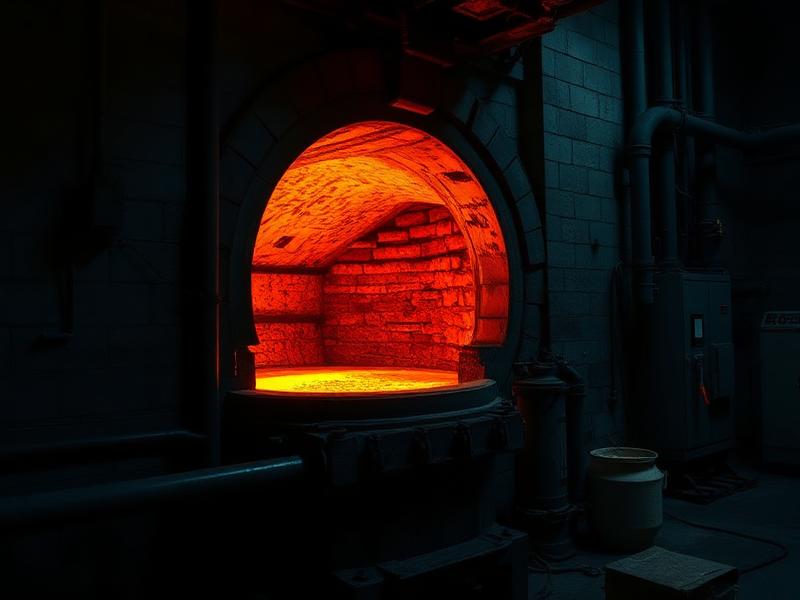
1,500–1,600 °C
Glass industry refractory solutions
Melting-end linings engineered for 8–15 year campaigns without glass contamination.
- Operating temperature
- 1,500–1,600 °C
- Campaign length
- 8–15 years
- Critical criterion
- Glass quality / low contamination
- Atmosphere
- Oxidising, alkali vapour rich
Kiln characteristics
Glass furnaces operate continuously for 8–15 years with molten glass temperatures reaching 1,500–1,600 °C. The lining is permanently in contact with molten glass, alkali-rich vapours and radiant heat, and it cannot be repaired without shutting the whole furnace down. Every kilogram of refractory that dissolves ends up as a defect in the finished glass, so corrosion resistance and low stone/cord potential matter more than raw refractoriness.
Main challenges
Molten glass corrosion
The metal line of the melter tank dissolves fastest — local convection currents accelerate the attack and drive the classic 'metal-line cut'.
Alkali vapour attack
Na₂O and K₂O vapours condense in the superstructure and regenerator, forming low-melting phases that soften and spall the lining.
Glass contamination
Eroded refractory grains become stones, cords and bubbles in the finished glass — a defect cost far higher than the refractory itself.
Creep and thermal expansion
Silica crown blocks work close to their softening point; unmanaged expansion causes crown sag and joint opening.
Campaign life pressure
Any unplanned cold repair costs weeks of lost production, so lining life must be designed with margin, not to average wear.
Our engineering approach
- 01
Zone-matched corrosion grade
Fused-cast AZS grades are graduated by ZrO₂ content — highest at the metal line and throat, reduced where corrosion is milder, so cost follows risk.
- 02
Low-exudation, low-blister grades
Materials are selected for low glassy-phase exudation so the melter does not seed stones and blisters during the first months of the campaign.
- 03
Insulation to control the isotherm
Backup lightweight silica and ceramic-fibre layers hold the hot face temperature stable, cutting energy use and slowing corrosion kinetics.
- 04
Controlled heat-up
We supply heat-up and cooling curves with the lining so silica conversion and AZS thermal shock are managed during commissioning.
Recommended products by zone
| Zone | Recommended material | Why it works |
|---|---|---|
| Melting zone / tank | Fused-cast AZS (zirconia-alumina-silica) blocks, zirconia bricks | Highest resistance to molten glass corrosion at the metal line with minimal defect generation. |
| Superstructure & crown | Silica bricks, high-purity mullite and sillimanite bricks | Low creep and good resistance to alkali vapour at crown temperature. |
| Regenerator / heat storage | Honeycomb (checker) refractories, magnesia and magnesia-zirconia checkers | Thermal shock endurance under cyclic reversal plus resistance to condensed alkali sulphates. |
| Insulation layer | Lightweight silica bricks, aluminium-silicate fibre blanket | Reduces shell temperature and fuel consumption without loading the hot face. |
Other industries
≈1,450 °C
Cement industry
Rotary-kiln linings for burning, transition and cooling zones under alkali, sulphur and clinker abrasion.
up to 1,700 °C+
Metallurgical industry
Blast furnace, converter, EAF, ladle and tundish linings for steel and ferroalloy plants.
900–1,600 °C
Electric power industry
Boiler, CFB and biomass linings engineered against fly-ash erosion and sulphur corrosion.
1,100–1,300 °C
Lime (calcium) industry
Rotary and shaft lime kiln linings for calcination, transition and preheating zones.
850–1,200 °C
Waste incineration industry
Municipal and hazardous waste incinerator linings for the most aggressive chemistry in the industry.