
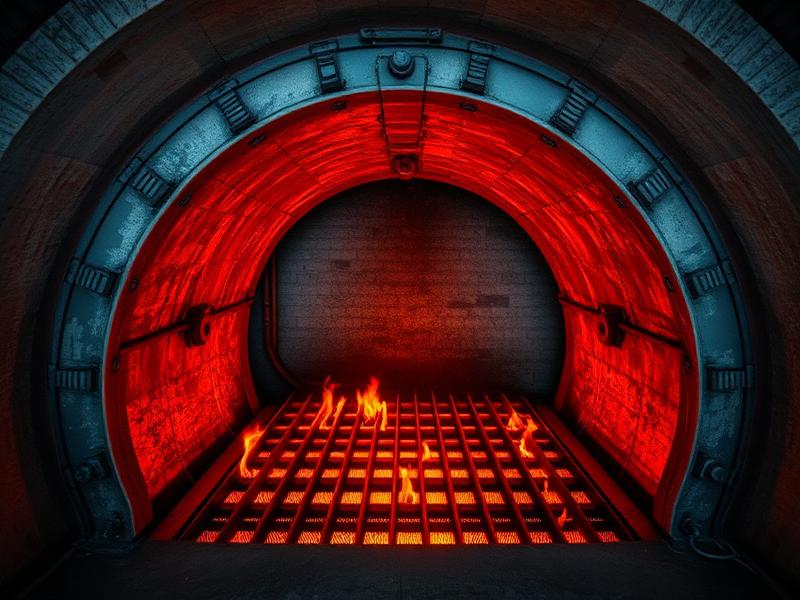
850–1,200 °C
Waste incineration industry refractory solutions
Municipal and hazardous waste incinerator linings for the most aggressive chemistry in the industry.
- Operating temperature
- 850–1,200 °C
- Outage interval
- 12–24 months typical
- Main driver
- Chloride and alkali chemistry
- Atmosphere
- Alternating oxidising / reducing
Kiln characteristics
Municipal solid waste, hazardous waste and rotary kiln incinerators operate at 850–1,200 °C with a two-second secondary combustion requirement. The feed is chemically uncontrolled: chlorides, alkalis, sulphur, heavy metals and moisture vary hour by hour, and the atmosphere alternates between oxidising and reducing. This is the most aggressive service environment in the refractory industry and lining life is measured in one- to two-year outage intervals.
Main challenges
Chloride corrosion
HCl and metal chlorides penetrate porosity and corrode both refractory bonding phases and the steel casing behind them.
Sulphate and alkali attack
Sodium and potassium salts condense in cooler sections, expand in the pores and spall the hot face.
Thermal shock
Wet or high-calorific feed batches swing the chamber temperature sharply within minutes.
Ash abrasion and slagging
Molten ash sticks to the lining, then tears material away when it is removed during cleaning.
Redox fluctuation
Alternating oxidising and reducing conditions destabilise iron- and silica-bearing phases in conventional materials.
Our engineering approach
- 01
Low-porosity, low-silica hot faces
High-alumina and corundum grades with minimal free silica resist chloride and alkali penetration far better than fireclay.
- 02
SiC linings on waterwalls
Silicon-carbide tiles and castables protect membrane walls from chloride corrosion while keeping heat transfer high.
- 03
Anti-slagging surfaces
Dense, smooth-cast surfaces reduce ash adhesion and make scheduled cleaning far less destructive.
- 04
Designed for outage-window relining
Panelised and gunnable systems allow the hot face to be renewed inside a short planned outage.
Recommended products by zone
| Zone | Recommended material | Why it works |
|---|---|---|
| Primary combustion chamber | High-alumina bricks, high-alumina and SiC castables | Resists chloride/alkali attack plus ash abrasion at 850–1,100 °C. |
| Secondary combustion chamber | Corundum castables, mullite bricks | Holds the two-second burnout zone at 1,100–1,200 °C with low contamination. |
| Waterwall / membrane wall | SiC tiles and SiC-based gunning mixes | Corrosion barrier that still allows heat transfer to the boiler. |
| Flue gas treatment & ducting | Acid-resistant castables, high-temperature insulation | Prevents acid dew-point corrosion downstream of the boiler. |
Other industries
1,500–1,600 °C
Glass industry
Melting-end linings engineered for 8–15 year campaigns without glass contamination.
≈1,450 °C
Cement industry
Rotary-kiln linings for burning, transition and cooling zones under alkali, sulphur and clinker abrasion.
up to 1,700 °C+
Metallurgical industry
Blast furnace, converter, EAF, ladle and tundish linings for steel and ferroalloy plants.
900–1,600 °C
Electric power industry
Boiler, CFB and biomass linings engineered against fly-ash erosion and sulphur corrosion.
1,100–1,300 °C
Lime (calcium) industry
Rotary and shaft lime kiln linings for calcination, transition and preheating zones.